The number stops. The child does not.

Diagnosis was counted. Care was not.
One child. Two clocks.
Counted by NAWI. Not counted.
- The role: What work is the intermediary responsible for?
- The hand-off: What changes when a family moves between organizations?
- The answer: Who remains accountable for the final outcome?
The argument in 30 seconds
One metric. Two missing waits.
Referral to assessment outcome, not time to funded service.
MCCSS FOI via OAC · May 2026; excludes children awaiting diagnosis.
Put time to funded therapy beside diagnostic wait on the same dashboard.
The table · four views
Who is served. Who keeps waiting.
A private layer now sits between diagnosis and funded care.
The official clock stops while the family remains at the table.
Administration is funded in full while therapy remains capped.
Timely funded support stays out of reach while the system manages the queue.
There is a national effort underway to fix something everyone agrees is broken: the time children wait for autism care. The National Child Autism Waitlist Initiative — NAWI, housed under the Autism Alliance of Canada — is standardizing how that wait gets measured across provinces, so the numbers can finally be compared, benchmarked, and reported on a public dashboard.1 On its own terms it sounds unarguable. You cannot fix what you do not measure.
But read what NAWI has decided to measure. In September 2024 the initiative convened clinical site leaders and a group of parents to define the key milestones — the “Date of Referral,” the “Wait Time” — and reached consensus on those definitions. Every one of them sits inside the diagnostic process: from the moment a child is referred to the moment a clinician confirms or rules out autism.1
That is one wait. It is real, and for many families it runs from several months to a couple of years. But it is not the wait that has made Ontario notorious.
The metric
Two waits, not one.
The first wait is the wait for a diagnosis — referral, to assessment, to verdict. The second begins the day the diagnosis is delivered: the wait for the funded therapy the diagnosis is supposed to bring. In Ontario, that second wait is where children disappear. Of the 91,974 children registered in the Ontario Autism Program as of May 2026, just 20,711 — fewer than one in four — hold a funding agreement for services. The other 71,263 are waiting, many for more than five years.2
NAWI’s metric captures the first wait. It ends at diagnosis. The second wait — the years a diagnosed child spends with a binder full of paperwork and no therapist — falls entirely outside the number.
This is not a technicality. It is the whole game.
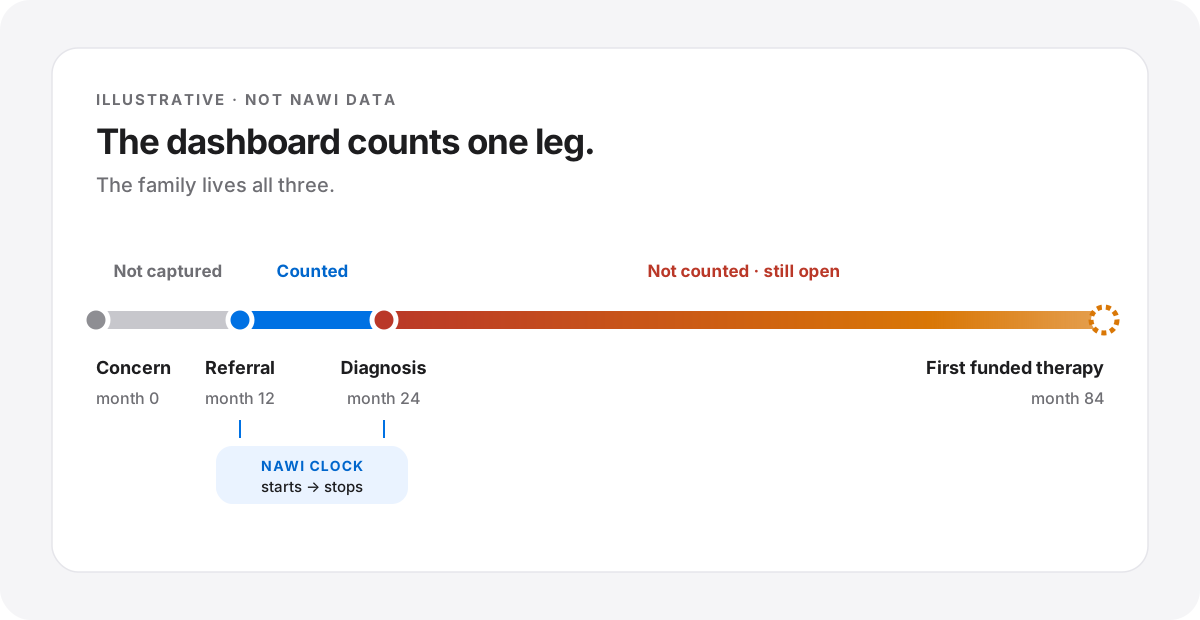
The wait a parent actually lives has three legs, not one:
- First concern → referral. The “wait and see,” the rounds of GP visits, the months it takes just to get onto a referral list. Often one to three years.
- Referral → diagnosis. The diagnostic assessment queue itself. Months to roughly two years.
- Diagnosis → funded therapy. In Ontario, the OAP core-funding wait. Five years or more.
NAWI’s clock starts at the second leg — the “Date of Referral” — and stops at the end of it, the day a diagnosis is confirmed. The first leg and the third, the two longest, both fall outside the window. This is not a matter of reading between the lines: NAWI’s own account concedes that the pre-referral period “is currently not captured,” and the entire metric is scoped to assessment and diagnosis.1 The third leg — the funding wait — never enters the frame at all, because OAP funding is a post-diagnosis service and the clock has already stopped.
Put real durations on it. The structure below is documented; the specific years are an illustrative example, not NAWI’s own figures:
- Month 0 — a parent first raises a concern. The lived wait begins.
- Month ~12 — the referral is finally logged. ← the NAWI clock starts
- Month ~24 — an autism diagnosis is delivered. ← the NAWI clock stops, reporting a wait of about 12 months
- Month ~84 — funded therapy actually begins. The lived wait ends.
Exhibit detail: Exhibit 01 · The missing years
Exhibit 01 · The missing years
The lived wait has three legs. The dashboard counts one.
The most important wait is the one most likely to disappear from the national number.
Exhibit detail: Exhibit 02 · Where children are now
Exhibit 02 · Where children are now
Only 23 of every 100 registered children hold an active agreement.
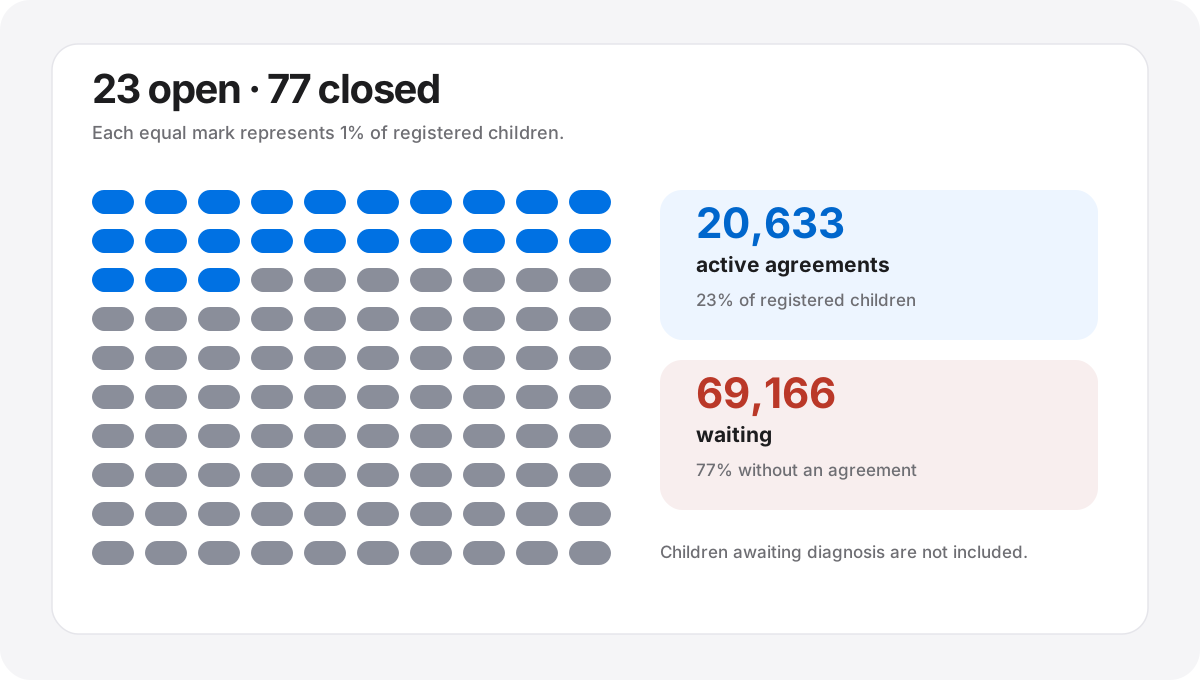
Children awaiting diagnosis are not even in this count.
Lived wait: about seven years. NAWI-reported wait: about twelve months. Nobody fabricated the twelve months — it is a real interval. It is simply not the wait.
And here is the part that survives a fact-checker: NAWI does not hide that it measures diagnostic wait — it says so plainly. The distortion is not in the fine print. It is in what happens when that number becomes the national wait-time figure on a public dashboard, with no competing national number standing beside it for the funding wait. “Autism wait time: twelve months” gets read by reporters, the public, and politicians as the wait for autism help — not the wait for an assessment. A dashboard built on time-to-diagnosis can show steady improvement — more clinics, faster assessments, shorter diagnostic queues — while the number of children waiting for actual therapy stays exactly where it is. And because the five-year funding leg has no standardized national metric of its own, it produces no benchmark, no line on the chart, no figure to quote. The number that would embarrass a government never gets generated, because the system was never asked to generate it.
A problem with no number is, politically, a problem that does not exist.
The consensus
Who agreed to the definition.
It matters who set the boundary. NAWI’s wait-time consensus was reached by diagnostic clinicians — the people whose work sits at the diagnostic stage.1
This is not an accusation; it is a structural fact with a predictable consequence. Ask the people who run the diagnostic bottleneck to define “the wait,” and you will get a definition that centers the diagnostic bottleneck. The metric validates the part of the system they can see and measure, and quietly excludes the part — funded treatment — that lives in a different budget, under a different ministry, with a far longer queue.
When the wait is measured only to diagnosis, the five years that follow become, on paper, no wait at all.
The convergence
The party with money on the table.
Accerta — through Accerta Services Inc. — leads the consortium that runs AccessOAP, the independent intake organization that is the front door to the Ontario Autism Program; its partners are Autism Ontario, McMaster University, and a care-coordination firm. It is, in other words, the operation that holds the database where the children wait. In 2023–24 that intake operation drew an estimated $57.9 million — the single largest non-therapy line in the program’s budget, in a year when less than half of all OAP spending reached the core clinical services children are waiting for. (This is AccessOAP’s specific intake-administration line, not the Accerta corporate group’s total government business — see below.)9
That $57.9 million figure is one program, one year. Zoomed out, using ETWO’s own computation from the primary Ontario Public Accounts Detailed Schedule of Payments dataset (data.ontario.ca, FY2014–15 through FY2024–25), payments to the Accerta corporate group across all Ontario ministries totalled an estimated $2.89 billion over those eleven fiscal years. Combined annual payments rose from $202.5 million in 2018–19 to $672.2 million in 2024–25 — a 232% increase. (A commonly repeated version of this figure mislabels the $672 million year as 2023–24; the actual FY2023–24 total was $573.0 million, a 183% increase. We cite data.ontario.ca directly rather than the secondary report this error originated in.)
Separately, Accerta has maintained a continuous registered lobbying presence with the government of Ontario since at least 2015 — distinct from, and in addition to, its federal lobbying activity discussed below. Ontario Lobbyists Registry records show 27 registrations from June 2015 through October 2025, three of which remain active. The registry’s search results do not expose each registration’s specific subject matter, so this documents a continuous relationship with the province, not a confirmed autism-specific lobbying record.
In October 2024, eleven days after the federal government launched its National Autism Strategy, Accerta amended its federal lobbying registration to add the Strategy as a subject matter. In 2025 it logged direct meetings with designated public office holders at Finance Canada and Veterans Affairs Canada. During the same stretch it added Government Procurement to its file, with stated intent to seek federal Requests for Proposals — its own words on the public record: it wants to compete for the contracts.3
For all the language of transformation and innovation, what Accerta actually does is administrative: it registers families, confirms eligibility, and tracks and reconciles the movement of money. Its consortium partners bring the autism expertise and the care coordination; Accerta brings the back office. In plain terms, it is a glorified payment processor.
And in its most recent filing, that payment processor disclosed that it had applied to the federal AI Compute Access Fund — a $300-million program that awards between $100,000 and $5 million to help companies build and commercialize AI products — and that it wanted to engage federal decision-makers about its investment proposal.45 The filing describes “an AI platform.” It does not, on its face, say the platform is about autism. But Accerta does not need the filing to say so. It already holds the national-scale autism intake data that any “national dashboard” would have to be built on top of.
Line the pieces up. NAWI is defining the national wait-time standard. A national standard implies a national platform to run it. Accerta already operates the largest autism intake system in the country, is lobbying on the national strategy, has told Ottawa in writing that it wants the procurements, and is seeking federal money to build an AI platform. Whether those threads were ever meant to meet is not something a filing can prove. That they are converging is simply what the public record shows.
The market that forms around a line
The connection shown is this article’s interpretation, not proof of a joint plan, contract, or coordination.
The summit
Three days at the Château Laurier.
To see what the apparatus looks like when it is spending money, look at the Canadian Autism Leadership Summit. It is run by the Autism Alliance of Canada — the same organization that houses NAWI and its diagnostic-wait metric. In April 2026 it held its twelfth annual edition: sold out, three days, at the Fairmont Château Laurier, one of the grandest hotels in Ottawa.6
The theme was “Beyond the Now.” The language was “from strategy to action,” “accountability,” “systems change.” The headline event was a full day given over to an AI symposium — “AI and Autism: Innovation for Inclusion” — featuring major technology companies and startups pitching AI platforms to “reduce waitlist burden.”67 Around it: panels on system navigation, research posters, a leadership award, a federal public-health vice-president, senators, and a concurrent “Autism on the Hill” engagement on Parliament Hill.7
Exhibit detail: Exhibit 03 · Published program
Exhibit 03 · Published program
One of three summit days was explicitly organized around AI.
- Responsible AI leadership dialogue
- Industry skill-building labs
- AI tools and real-world applications
- Rethinking system navigation
- Research posters and member showcase
- Parliamentary reception
- Community-driven system design
- Evidence to systems change
- Neuro-affirming care
Therapy funding: not on the agenda as a direct service slot.
The summit also runs on corporate money, and it sells access by tier. The Alliance’s own sponsorship proposal offers “support” levels that have run from $5,000 for an entry “Bronze” session sponsor up to $25,000 and beyond for the lead “Platinum” supporter — the upper tiers buying logo placement across the Summit’s materials and, at the top, the chance to deliver welcoming or closing remarks from the stage.8 This is, to be fair, how most non-profit conferences are funded. But it means a company can pay to put its brand on the country’s premier autism-policy gathering, and pay a little more to speak from its podium — at the same event where the proposed answer to the waitlist is, increasingly, a commercial AI platform.
Read that list again and notice what is missing from it: therapy money. The entire summit orbits the wait — nearly every session is, in some sense, about the wait — and yet its centre of gravity is conferencing, branding, leadership, and above all technology. The answer offered in the room is an AI platform, a data system, a navigation tool. Not a cheque to a provider so that a five-year-old can begin treatment this year instead of at eleven.
This is what managing the smell looks like in practice: a sold-out summit at a grand hotel, themed on accountability, headlined by some of the largest technology companies in the world, convened by the very body that drew the wait-time metric so the funding wait produces no number — while the funding wait itself, the thing the whole gathering is organized around, continues exactly as before. The activity is real. The spend is real. The optics of action are real. The action is not.
Be precise about the charge. This is not to say the researchers, self-advocates, and families in the room are acting in bad faith; many are doing serious work, and convening has real value. The point is structural, and it is about proportion. When the most visible, best-funded, most photographed expression of a “waitlist crisis” is a three-day leadership summit with an AI symposium at the Château Laurier, the system has learned to perform concern at a level of polish it has never once brought to actually paying for care.
The gate
The middle layer nobody asked for.
Strip away the summit and the dashboard and look at the shape of the thing underneath. Between the government that funds autism therapy and the family that needs it, Ontario has inserted a private administrative layer — an intake contractor that registers children, determines their funding, and runs the gate. The question worth asking, plainly, is what that layer is for.
There is a respectable answer, and it deserves to be stated fairly. The case for letting private operators into a public service is value: that a contractor will run the thing faster, cheaper, or better than the state would manage on its own, and that the efficiency it adds is worth the margin it takes. That is the entire justification for market involvement in something like health care. If it holds, everyone gains — the public buys a better outcome than it could build for itself, and the operator earns its keep by delivering it.
So test the arrangement against its own justification. The outcome that matters is simple: a diagnosed child receiving funded therapy while the therapy can still do the most good. On that measure the wait has not shrunk — many now wait more than five years, with 71,263 children registered and still unfunded.2 More money has gone in — the province raised the program budget to $965 million for 2026-27 — yet the share of registered children actually receiving funded services has barely moved in a year and a half, even as registrations keep climbing.2 The deepest bottleneck is funding, and no amount of intake administration substitutes for it. But that is exactly the point: whatever value the private layer was supposed to add, it has not reached the place it was promised to reach — the time a child waits. The public is paying for a middleman whose central promise, faster access, remains undelivered.
Exhibit detail: Exhibit 04 · The administrative gate
Exhibit 04 · The administrative gate
The intermediary is funded to operate the path, not the therapy slot.
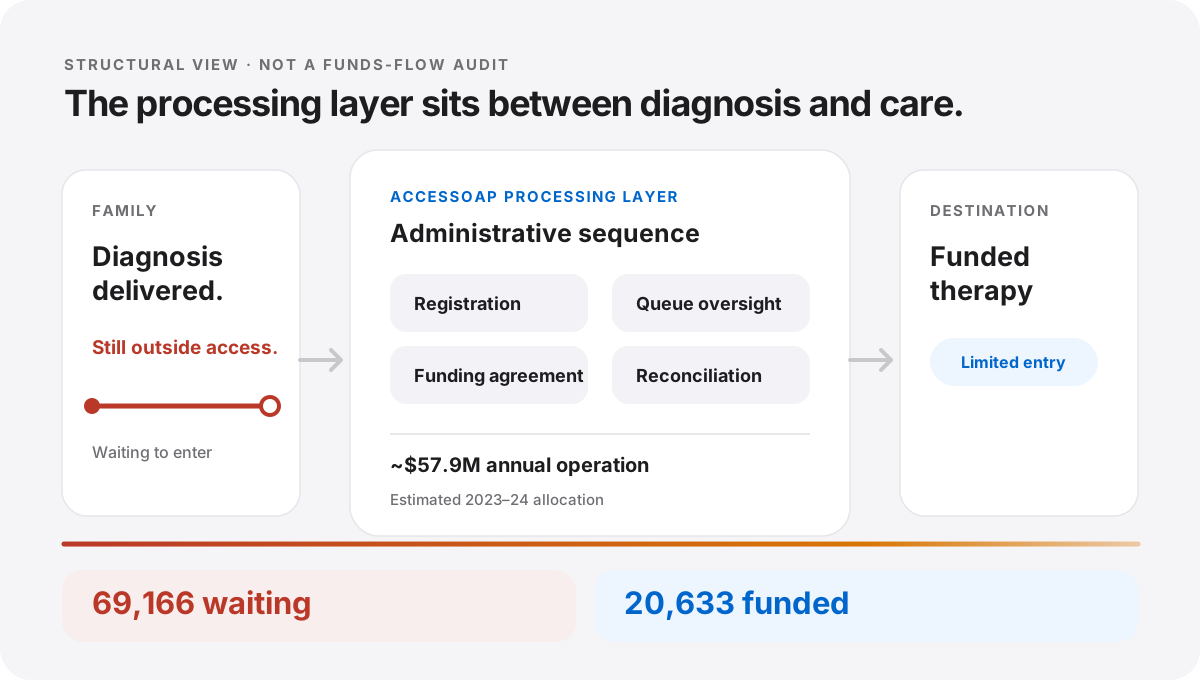
Exhibit detail: Exhibit 05 · The stakeholder ledger
Exhibit 05 · The stakeholder ledger
Who carries the wait?
| Party | What they carry | What they risk | Position if the wait continues |
|---|---|---|---|
| Family | Developmental time while waiting for a funding agreement. | Timely support delayed. | Worse |
| Taxpayer | Both the therapy and the access machinery around it. | Funding the gate as well as the care. | Worse |
| Government | The capped budget and the politics of the queue. | Public accountability. | Exposed |
| Intermediary | Administration of access while demand exceeds funded capacity. | Contract scrutiny. | Still paid |
Now follow the money through the arrangement and ask who, inside it, is actually better off. The family waits through years it cannot get back, even though learning and development continue. The taxpayer funds both the therapy budget and the apparatus built around it — paying, in effect, for the gate as well as for whatever is supposed to lie beyond it. The government spends, and absorbs the political damage of a wait it can no longer hide. And the intermediary is paid to administer the queue — its revenue attached to running the gate, not to getting children through it. On that ledger, the only party whose position improves no matter how long the wait lasts is the one in the middle.
This is the part that should land hardest: no one asked for that middle layer except the people who stand to profit from it. Families did not lobby to have a contractor inserted between them and their child's therapy. The public did not demand it. It is the middleman no one invited to dinner — and it is the one leaving full. The pressure to entrench and expand the arrangement — to win the federal contracts, to build the national data platform, to position for the next procurement — comes, on the public record, from the operators themselves.3 The demand is manufactured by the supplier: a market talked into existence by the party it benefits.
That is the test private medicine has to pass, and this arrangement fails it. A private layer earns its place by delivering value the public could not get otherwise. This one delivers a slower, more expensive, more elaborately managed version of the same wait — while drawing funding, data, and political attention toward itself and away from the children it exists to serve. When the layer in the middle is the only winner, it is not private medicine working. It is rent, dressed as reform.
The test
The tail wagging the dog.
The apparatus for measuring the wait is becoming more elaborate, better-funded, and more authoritative than the effort to end it. A national initiative, a community dashboard, federal strategy meetings, an AI platform, a procurement pipeline — a growing enterprise organized around a number. And the number has been defined so that it can show progress without a single additional child receiving therapy. It is the most expensive, most sophisticated, and ultimately most useless kind of wait: the kind that is managed for how it looks rather than shortened for how long it is.
None of this requires bad faith from any individual. It requires only that everyone keep measuring the wait that is convenient and avoid the wait that is not. A diagnostic clinician measures the diagnostic queue. A government reports the metric that flatters it. A contractor builds the platform that runs it. Each step is reasonable. The sum is a polished, well-documented account of a problem that leaves the problem untouched.
A summit, a symposium, a dashboard — the wait has been given a production. It has not been given an end.
Exhibit detail: Exhibit 06 · Dashboard versus reality
Exhibit 06 · Dashboard versus reality
A public metric can improve while the therapy wait remains untouched.
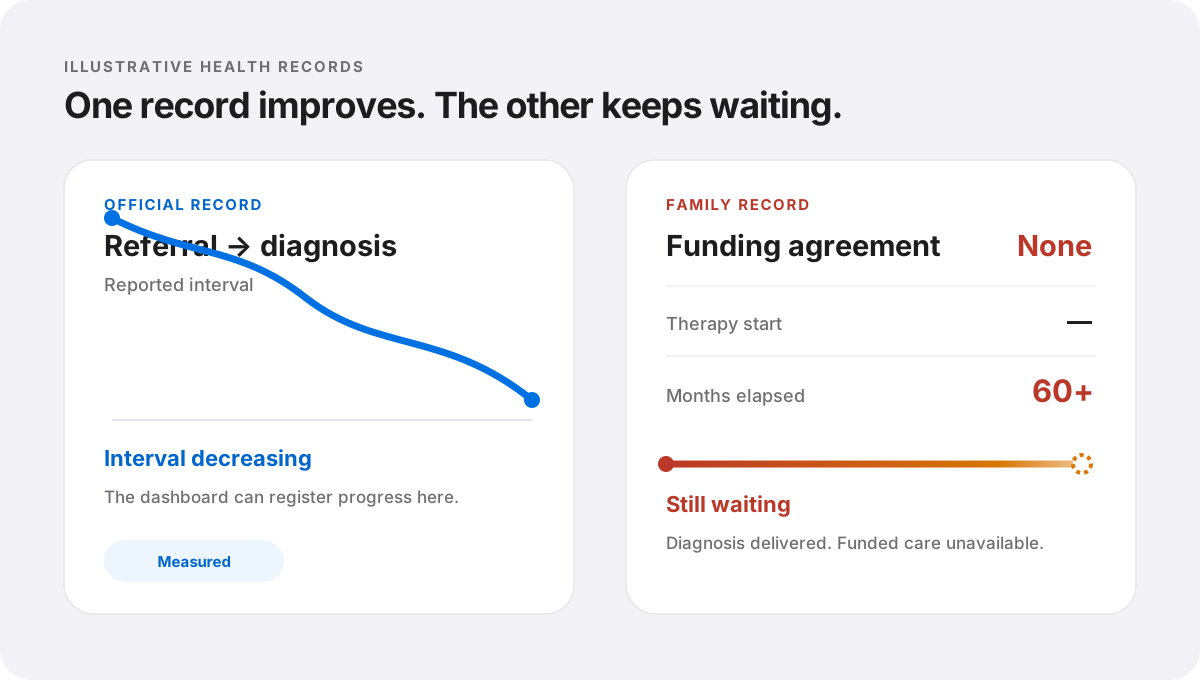
Exhibit detail: Exhibit 07 · What the dashboard should say
Exhibit 07 · What the dashboard should say
Put the visible metric beside the wait families are actually living.
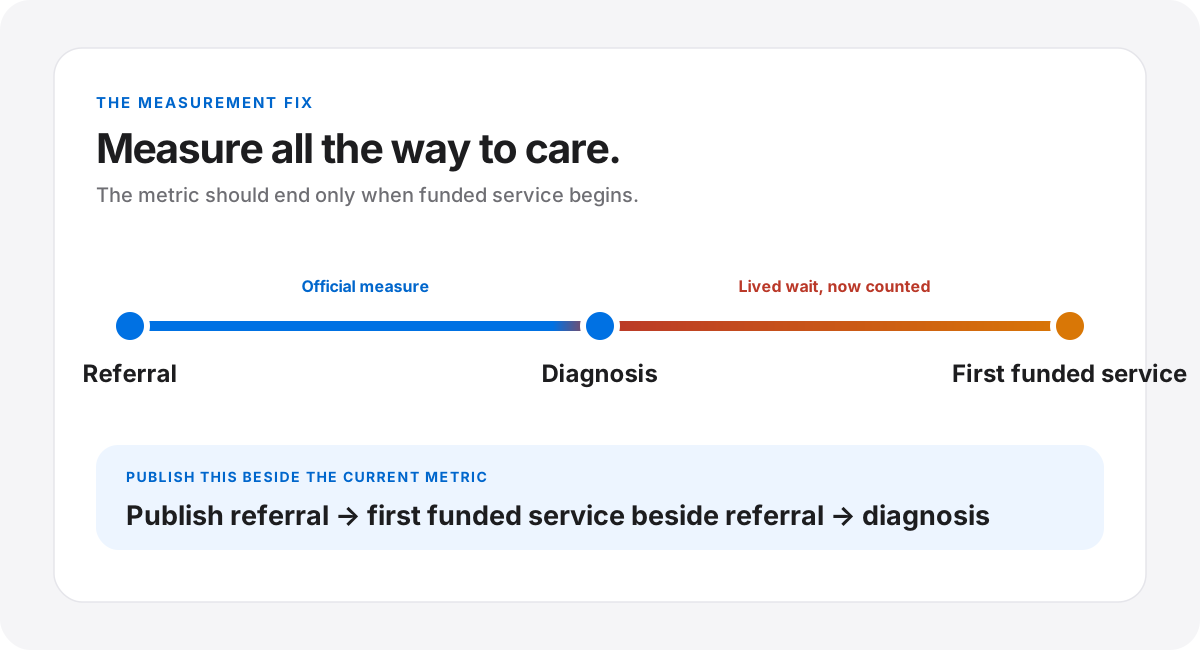
Publish Referral → first funded service alongside Referral → diagnosis.
Timely access matters across development. Metrics should expose the full wait, not erase it.
The fix is one sentence long. Measure time to funded therapy — referral to the first dollar of service a child actually receives — not time to diagnosis. Publish that number, province by province, on the same dashboard. Until the metric counts the years a diagnosed child waits with nothing, the dashboard is not measuring the crisis. It is managing the optics of it.
The pattern
The loudest voice in the room.
Step back far enough and the autism file starts to look like a test case for something much larger. Brown University researchers identified 574 autism therapy centers under private-equity ownership across 42 states, with nearly 80% of those acquisitions concentrated between 2018 and 2022 (Arnold et al., JAMA Pediatrics 2026, doi:10.1001/jamapediatrics.2025.5443), and a separate economic-research group found private equity firms completed the large majority of mergers and acquisitions in the sector over the same stretch (Batt, Appelbaum & Nguyen, CEPR 2023).
To be precise about what that parallel does and does not claim here: a dedicated search of Accerta’s corporate filings, its consortium partners, and available commercial-database records found no evidence of US private-equity ownership, investment, or acquisition in Accerta’s corporate history; it publicly holds B Corp certification and states it reinvests earnings domestically. What the pattern above documents is structural — a broader shift, elsewhere, toward intermediary-heavy administration in autism services — not an ownership claim about Accerta specifically.
The structural shift is still the relevant one. A layer of administrators and “navigation” services sitting between the dollar meant to buy treatment and the treatment itself, each taking its cut, each insisting it is indispensable — that intermediary layer is the defining feature of the system Canadians have spent generations saying they do not want. On the autism file it has arrived without anyone voting for it: a private contractor at the gate, a national initiative defining the metric, a leadership summit headlined by technology platforms, and a lobbying campaign for the contracts to run all of it.
And it is that layer — the administrators and intermediaries, not the clinicians and therapists who do the actual work — that has become the loudest, best-funded voice in the room. At the Château Laurier, the summit’s top sponsorship tier — $25,000 — buys whoever holds it the lead supporter’s standing and the chance to deliver the welcoming or closing remarks.8 It files the federal lobbying registrations and takes the meetings at Finance Canada. And whatever its particular wording, the ask that reaches government points the same way: more administration, more data infrastructure, more platforms, more experts to manage the management. Every one of those asks routes money into the middle of the system rather than out the far end of it, where the child is.
Much of the need it claims to be meeting is need the structure itself creates. Strip the apparatus away and the underlying ask is straightforward: timely funding for the individualized supports a child needs. For some children that includes professional therapy; no single therapy or intensity fits every autistic child. Portals, navigation tools, dashboards, and summits cannot substitute for the funded service a family has been assessed to use.
Instead, less than half of what Ontario spends on the program reaches the core clinical services that hour belongs to.9 Much of the rest funds other non-clinical parts of the program — and the single largest non-therapy line is the contractor that runs the gate.9 Its answer to its own waitlist is to ask for more money to expand itself.
That is the peak of it. A public program reorganized so completely around its own administration that the loudest voices in the country’s autism conversation are no longer the families who live the wait or the therapists who could end it, but the intermediaries who profit from the distance between the two. In that arrangement the wait is not a malfunction. It is the room the middle layer lives in.
Families need the system to fund the appropriate support in time. Everything else in the room is a negotiation over who gets paid while they wait.
The public ask
Ask for the number that reaches care.
Ontario should publish, every quarter, the median and 90th-percentile time from referral to first funded autism service, beside diagnostic wait time. Not just referral to diagnosis. Not just registration counts. The number that matters is the one that follows a child all the way to funded care.
Email your MPP and ask for that metric on the public dashboard.
Full source trail (9 records)
Source trail
Every solid line in the story.
- National Child Autism Waitlist Initiative. Autism Alliance of Canada’s project page describes the diagnostic scope, community dashboard, September 2024 consensus meeting, and the pre-referral period that is “currently not captured.” Open primary source
- Ontario Autism Program counts. MCCSS bi-weekly Core Clinical Services progress reports obtained through FOI release CSS2026-0749; canonical ETWO data updated to May 13, 2026. CBC published the January 2026 snapshot and the preceding 18-month trend. Open the data hub
- Accerta federal lobbying and AccessOAP role. ETWO’s source-linked record of registration amendments, communication reports, procurement language, and the AccessOAP consortium. Open the investigation
- Registry of Lobbyists. AccertaClaim Servicorp Inc., subject matter details, including the AI Compute Access Fund application and request to engage decision-makers about the proposal. Open federal registry
- AI Compute Access Fund. Innovation, Science and Economic Development Canada’s program page and guide: up to $300 million, with eligible project costs from $100,000 to $5 million. Open primary source
- CALS2026 announcement. Autism Alliance of Canada describes the sold-out April 14-16 summit at the Château Laurier and its full-day AI and Autism symposium. Open primary source
- CALS2026 published program. Session descriptions, speakers, member showcase, system-navigation panel, and parliamentary reception. Open primary source
- Historical CALS support proposal. Autism Alliance of Canada’s published 2023 corporate-support tiers and benefits. The article does not present them as current 2026 rates. Open the proposal
- AccessOAP allocation. The Trillium reported an estimated $57.9 million for AccessOAP in 2023-24 from ministry documents obtained through Freedom of Information. Open reporting
Fact versus analysis. Solid-line graphics summarize published records. Dashed-line graphics mark this article’s inference. Nothing here alleges improper lobbying, misuse of public funds, breach of contract, or a coordinated procurement plan by Accerta, Autism Alliance of Canada, AccessOAP, or their partners.
Corrections and right of reply. End The Wait Ontario invites any named party to respond. Material corrections are published under the site’s corrections policy.
Continue the record